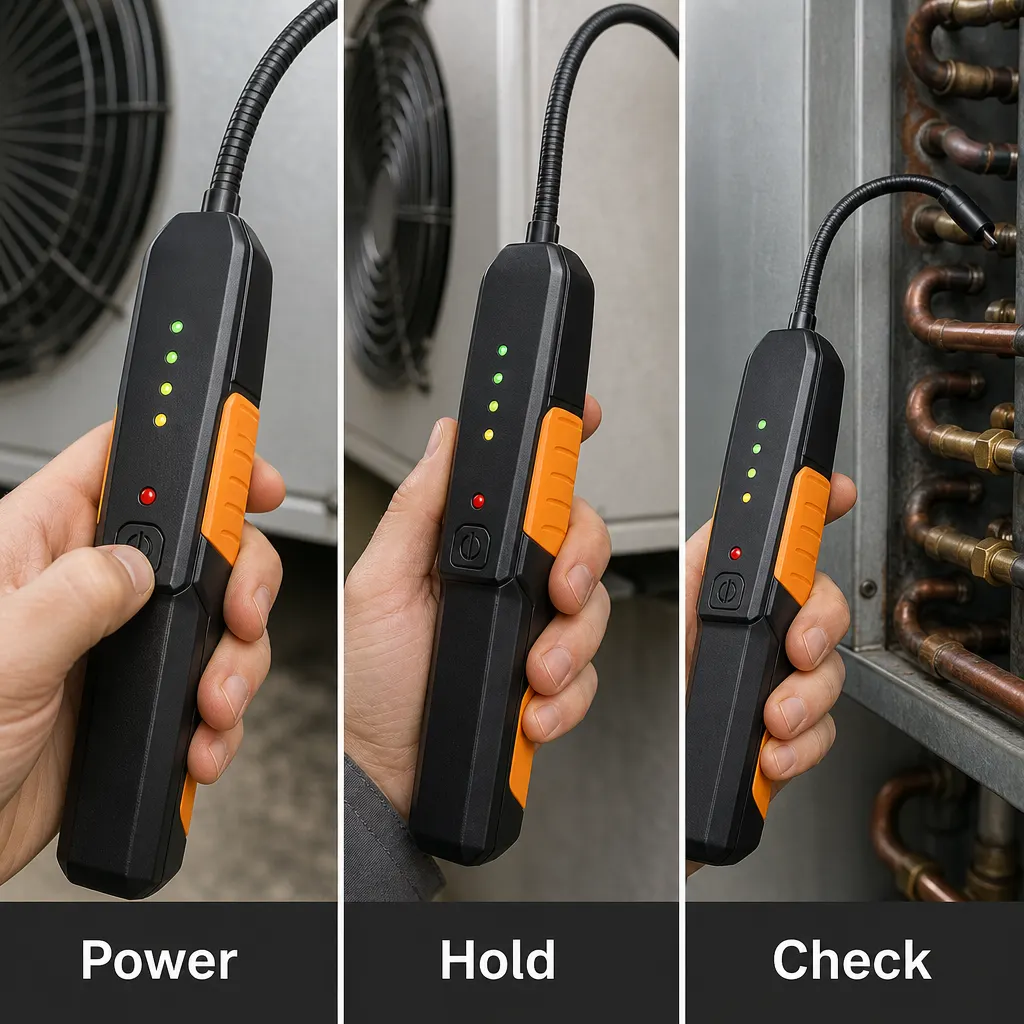
Choose a detector that matches the cold-room refrigerant and search conditions

Product use sequence

An electronic refrigerant leak detector for cold room work should, at minimum, have documented applicability to the refrigerant in the system, a usable way to establish a baseline in the room and alarm feedback that can be followed while narrowing the search. The testo 316-3 is documented as detecting common CFCs, HFCs and FCs, with automatic zero setting plus visual and audible alarms. Those facts make it relevant to a cold-room shortlist, but they do not remove the need to identify the installed refrigerant and read the operating instructions before relying on it at a commercial site.

For a UK refrigeration engineer, the buying decision is less about whether a detector can produce an alarm and more about whether that alarm can support an efficient, explainable investigation. A cold room may contain evaporator connections, valves, accessible joints, equipment panels and pipework exposed to vibration. The useful tool is the one whose documented refrigerant coverage fits the plant and whose alarm behaviour the engineer understands. If the refrigerant cannot be matched to the stated CFC, HFC or FC coverage, confirm compatibility through current product documentation rather than assuming that “common cooling agents” covers every system encountered.

Set the job around the cold room and its connected refrigeration plant

A cold-room call rarely consists of checking one obvious fitting. The room may be only one part of the installation, with the suspected source around the evaporator, connected pipework, valves or a separate refrigeration pack. Before starting, define which accessible sections belong to the investigation and note where earlier work, repeated loss of charge or vibration gives a reason to look closely. This turns an open-ended search into a planned sweep and gives the site manager a clearer idea of what the visit will cover.

Working methodically is particularly important when access is restricted by trading, food handling or production schedules. Begin with the documented system information available on site, identify the refrigerant, and decide which areas can be inspected safely and legitimately during the access window. The detector should help narrow the search rather than substitute for understanding the installation. Automatic zero setting may be useful where refrigerant is already present in the room, but it should not be treated as proof that every alarm is a precise leak location or that a non-alarm establishes the condition of inaccessible components.

Check the documented testo 316-3 facts before putting it on the van

The available product description identifies the testo 316-3 as a refrigerant leak detector for common CFCs, HFCs and FCs. It states sensitivity of less than 4 g/a, and 1 g/a according to DIN EN 14624:2012. It also states that refrigerant characteristics do not need to be selected before use. For an engineer moving between cold rooms and other cooling equipment, that simplified preparation may be attractive, provided the refrigerant on each job falls within the documented applicability and the full instructions support the intended procedure.

The detector is listed as using two D-size batteries and providing both visual and audible alarms when a leak is detected. Those are concrete points to compare with existing van equipment: the team needs to be willing to carry the required batteries, understand both alarm types and keep the instrument ready for a scheduled investigation. The available facts do not specify dimensions, weight, probe construction, battery runtime, warm-up time, sensor replacement arrangements or supplied kit contents. Buyers who depend on any of those details should obtain them before ordering rather than fill the gaps with assumptions based on other Testo models.

Understand what automatic zero can and cannot settle in a contaminated room

The stated automatic zero setting is intended to allow leak detection in rooms that are already contaminated. In practical terms, that addresses an important cold-room problem: background refrigerant can make it difficult to distinguish a general presence from a more concentrated source. A baseline feature can support a progressive search in which the engineer moves from the wider area towards individual joints or components. The exact timing, controls and interpretation of that process should come from the model’s current instructions, because those operating details are not included in the available product facts.

Automatic zero is not the same as identifying the leaking component. If the detector establishes its baseline near a strong source, or if the engineer moves too quickly between areas without understanding how the instrument responds, an alarm may still be hard to interpret. Treat the visual and audible indications as evidence to narrow the search, then repeat the approach around the suspected point in a controlled way. Where an indication cannot be repeated, record that uncertainty instead of presenting the first alarm as a confirmed repair target. This protects both the diagnosis and the conversation with the customer.

Use a repeatable cold-room leak-search sequence

Start with a job check: identify the cold room, its connected equipment and the documented refrigerant; confirm that it falls within the detector’s stated CFC, HFC or FC coverage; inspect the detector and make sure two suitable D-size batteries are available; then consult the operating instructions for preparation and any functional check required by the manufacturer. Do not infer readiness simply because the display or alarm powers up. The frozen product information supplied here does not document a functional-check method, maintenance interval or sensor-care procedure, so those points need to be resolved from current instructions before a critical visit.

Continue with a search check: establish the baseline as directed, survey accessible parts of the cold room and connected plant, and pay deliberate attention to joints, valves and vibration-prone pipework. When the visual or audible alarm changes, reduce the search area rather than immediately stopping at the first indication. Re-approach the suspected point to see whether the indication can be repeated. Finish with a record check: note the system area examined, the refrigerant identified, where the alarm occurred, whether it repeated and which areas were inaccessible. That working record separates an observed indication from an unsupported claim that the whole system is leak-free.

Avoid mismatches that turn a detector into another untrusted tool

Do not buy this model solely because the product description says it detects common cooling agents. A contractor servicing a mixed equipment estate should compare the actual refrigerants on that estate with the documented CFC, HFC and FC applicability. If a required refrigerant is not clearly covered, the available facts are not enough to settle suitability. The same caution applies if the work depends on a particular probe length, access shape, response time, environmental rating or battery duration: none of those details is documented in the supplied public facts.

The testo 316-3 may also be a poor choice for a buyer who expects a detector to provide a named leak location, quantify the leak rate on site or create a service report automatically. The documented feedback is visual and audible, while the sensitivity statement is a performance specification rather than a promise that the instrument will measure and display the rate of an individual leak. It should not be selected on the assumption that automatic zero eliminates nuisance alarms, compensates for every environmental influence or removes the need for a systematic investigation.

Compare the detector with the way your service team actually works

For a sole engineer, the relevant comparison may be between owning a ready detector and continuing to borrow one for urgent cold-room callbacks. For a contractor equipping another van, consistency matters: every engineer needs to understand the baseline behaviour and interpret the same visual and audible alarms in a comparable way. The absence of refrigerant-characteristic selection may simplify preparation, but it does not replace training, current instructions or a documented readiness routine. A tool that is technically suitable but poorly understood can still create inconclusive visits.

Compare candidates side by side using factual headings. Under refrigerant, write the exact system gases you service and check each detector’s documented coverage. Under setup, note that the testo 316-3 is stated to require no prior selection of cooling-agent characteristics and includes automatic zero. Under feedback, record its visual and audible alarms. Under power, record two D-size batteries. Under access, care and aftercare, mark the current evidence as incomplete because probe details, kit contents, maintenance guidance and functional-check instructions are not provided here. Any blank affecting your work should be answered before purchase.

Turn the site alarm into a defensible next step

A useful cold-room investigation ends with a specific statement about what was and was not found. If the detector repeatedly alarms around one accessible valve, joint or section of vibration-prone pipework, record the location and the repeatability of the indication so that the repair conversation has a defined starting point. If the alarm is broad, intermittent or cannot be reproduced, say so. An electronic indication can narrow a search, but the documented product facts do not support claiming that one alarm alone proves the exact fault or condition of the complete refrigeration circuit.

Before choosing the testo 316-3, make a short list of the refrigerants, cold-room layouts and access constraints in your current workload. Match those needs against its stated CFC, HFC and FC detection, automatic zero setting, no-selection preparation, visual and audible alarms, stated sensitivity and two-D-battery power. Then obtain the current operating and care information needed to close the gaps around setup, functional checking, access and maintenance. If those answers fit the way your engineers inspect and document cold-room faults, the detector can be considered on evidence rather than on brand familiarity or an unsupported promise of certainty.