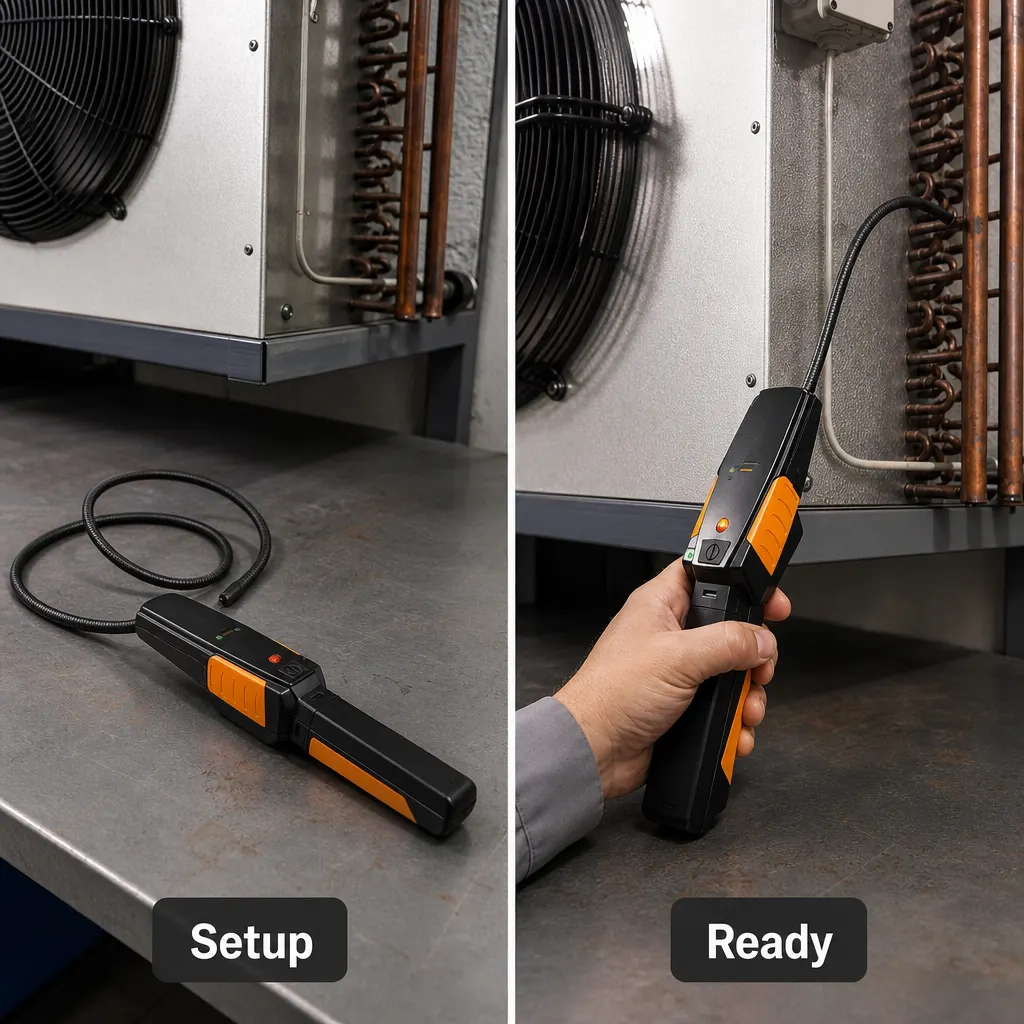
Choose the detector around the refrigerants and the leak-hunt workflow

The best refrigerant leak detector for HVAC engineer work is not automatically the model with the longest list of claims. Start by checking documented refrigerant coverage, preparation, baseline behaviour and alarm feedback against the systems you actually service. The testo 316-3 is documented as detecting common CFCs, HFCs and FCs, requires no refrigerant characteristic to be selected before use, has automatic zero setting, and provides visual and audible alarms. Those facts make it a relevant candidate for systematic searches in a commercial cold room or plant room, but they do not remove the need to confirm compatibility with the refrigerant on the specific system.
The practical buying question is whether those documented characteristics address the problem that prompted the purchase. If an existing detector produces alarms that cannot be narrowed down, concentrate on how a replacement establishes its baseline and communicates a detection. If engineers lose time selecting settings between jobs, the stated ready-for-use operation may matter more. If the business services mixed equipment, the listed CFC, HFC and FC coverage deserves close attention. A useful comparison therefore begins with the site workload and operating process, not with brand familiarity or a sensitivity figure viewed in isolation.
Match the detector to a UK cold-room or plant-room visit
A commercial refrigeration call often begins with an imprecise complaint: a cold room has lost charge again, a cellar cooler needs repeated attention, or a split system is not holding its previous condition. In a crowded plant room, the engineer may need to work around joints, valves, equipment panels and vibration-prone pipework while access time is limited. A broad indication that refrigerant is somewhere nearby is less useful than feedback that supports a controlled search of accessible areas and helps the engineer reduce the suspected area before discussing a repair.
Automatic zero setting is especially relevant to that setting because the testo 316-3 is stated to detect leaks in rooms that are already contaminated. This is a documented product characteristic, not a promise that every background vapour or difficult environment will be simple to interpret. The engineer still needs an orderly search rather than reacting to the first alarm as if it identifies the exact source. Visual and audible warnings can make a detection noticeable while attention is on pipework, but the value lies in using that feedback consistently as the suspected location is narrowed.
Check refrigerant coverage before comparing sensitivity
Compatibility should be the first firm gate in the comparison. The published description for the testo 316-3 says that it can detect common cooling agents across CFCs, HFCs and FCs. That is useful category-level information, but it should not be stretched into an unsupported statement about every refrigerant or every system an engineer may encounter. Before buying, identify the refrigerants used across the cold rooms, chillers, refrigeration packs, split systems or heat pumps in the intended workload, then compare that list with the product documentation available for the detector.
Only after that check should sensitivity enter the decision. The testo 316-3 is described as highly sensitive, with a stated figure of less than 4 g/a and 1 g/a according to DIN EN 14624:2012. That wording should be retained accurately rather than converted into a guarantee that a particular site leak will be found. Actual leak hunting also depends on access, the location of the source and the surrounding environment. The figure is useful for comparing documented specifications, but it cannot tell you whether the detector will physically reach a concealed component or whether the indicated refrigerant coverage matches an unfamiliar installation.
Decide whether automatic zeroing suits the contaminated plant room
The testo 316-3 has automatic zero setting and is described as being able to detect leaks in rooms that are already contaminated. For an engineer entering a plant room where refrigerant may already be present in the surrounding air, that feature directly addresses a common workflow concern: establishing a usable baseline without first selecting refrigerant characteristics. It may also reduce setup decisions when moving between service calls. This is different from claiming that the detector identifies the cause of every alarm automatically; zeroing establishes the operating reference, while the engineer still has to trace and isolate the source.
Compare this behaviour with the reason you distrust the current tool. If repeated manual adjustment or uncertain baselines are causing wasted time, documented automatic zeroing is a meaningful point in favour of this model. If the real difficulty is probe access behind panels or uncertainty about ongoing maintenance, automatic zeroing does not answer those questions. The frozen product information does not document probe dimensions, sensor replacement arrangements, filters, calibration routines or a functional-check process. Those gaps matter, particularly for a contractor equipping several vans, and should be resolved from current user documentation before purchase.
Interpret visual and audible alarms without treating them as a repair location
The testo 316-3 activates both a visual and an audible alarm when a leak is detected. Two forms of feedback can be useful in a noisy or visually crowded plant room because the engineer is not dependent on watching one display continuously. Nevertheless, an alarm should be treated as evidence that guides the search, not as proof that the nearest visible joint is defective. When several connections sit close together, the practical task is to use repeatable movements and progressively reduce the search area until the indication can be associated with a specific repair target.
This distinction matters when a site manager is challenging another visit for recurring refrigerant loss. Saying that a detector alarmed somewhere inside a cabinet is not the same as identifying the component that needs attention. The product facts establish that the 316-3 provides visual and audible warnings, but they do not document alarm levels, display detail or a method for recording findings. Buyers who need graded indications, stored readings or downloadable records should not assume those functions are present. Check the operating material for the exact alarm behaviour and plan to document the location and circumstances separately if required.
Use a concrete cold-room leak-hunt checklist
Before leaving the workshop, confirm the refrigerant used by the target cold room, chiller or split system and check that it falls within the detector’s documented applicability; for the testo 316-3, the published groups are common CFCs, HFCs and FCs. Confirm that two D-size batteries are available because that is the listed power source. Review the operating instructions for the model rather than relying on habits learned from another detector. Also check any documented care, readiness or functional-check requirements, because those details are not supplied in the available product facts and should not be guessed.
At the plant room, use the detector’s stated ready-for-use operation and automatic zero behaviour as directed by its instructions. Structure the search around likely accessible points such as joints, valves and vibration-prone pipework, moving from a broad survey towards a smaller suspected area. Note where the visual and audible alarms occur, then see whether the indication can be narrowed rather than accepting a single broad warning. After the search, record the system, refrigerant, location checked and finding in the format required for the job. Follow the manufacturer’s documented aftercare and storage guidance; no specific aftercare procedure is established by the supplied facts.
Recognise the mismatches before buying the testo 316-3
This detector should not be chosen on assumption if your workload includes refrigerants outside the documented CFC, HFC and FC groups. It may also be the wrong purchase where a contract requires capabilities not stated here, such as recorded measurements, a particular probe size, specified accessories or a defined digital reporting function. None of those details appears in the available facts. Likewise, the description does not establish suitability for a specific medical, safety-critical or compliance outcome. A responsible comparison treats missing information as a question to resolve, not as permission to infer that the feature exists.
There are practical ownership gaps to consider as well. The detector is listed as using two D-size batteries, but battery life is not documented in the supplied information. Sensor life, replacement parts, filters, calibration arrangements, warm-up behaviour and storage conditions are also unstated. That makes the current facts sufficient for an initial shortlist, but not necessarily for a complete fleet-ownership calculation. A small contractor replacing an unreliable detector should obtain and read the current operating and maintenance documents before deciding that this model will solve the same trust problem across every engineer and service van.
Compare the testo 316-3 with an alternative on evidence, not familiarity
Put the candidates side by side using the same headings. Under content compatibility, record the exact refrigerants or refrigerant groups each detector is documented to detect. Under setup, note whether refrigerant selection is required and how the baseline is established; the testo 316-3 requires no prior selection of cooling-agent characteristics and has automatic zero setting. Under feedback, record what the manufacturer actually states; here, that is a visual and audible alarm. Under power, note the documented source, which for this model is two D-size batteries. Leave an item blank if it is not published rather than filling the gap with an assumption.
Then compare the working environment and ownership questions. Check whether the documentation addresses contaminated rooms, access around the equipment you service, readiness checks, care, sensor or filter requirements and storage. The 316-3 description specifically links automatic zeroing with detecting leaks in already contaminated rooms, but the other ownership details are not established in the supplied facts. This approach may produce a less dramatic comparison table than marketing copy, yet it is more useful. It reveals whether one detector fits the cold-room job and whether missing documentation could create another untrusted tool in the workshop.
Make the next step a documentation check against one real job
Choose one representative call from your workload before making the final decision: for example, a recurring loss of charge from a commercial cold room with a limited access window. Write down the installed refrigerant, the likely areas you must reach, the expected plant-room conditions, how you need alarms to be communicated and what evidence must be recorded afterwards. Compare that job line by line with the testo 316-3 facts: common CFC, HFC and FC detection, no need to select cooling-agent characteristics first, automatic zero setting, visual and audible alarms, and power from two D-size batteries.
If those points match the job, obtain the current instructions and resolve the remaining questions about operation, functional checking, care and any consumable or sensor requirements. If the refrigerant or a required capability is not clearly covered, pause rather than buying on the strength of the sensitivity claim alone. At £362.99 including VAT, this is a purchase that merits a documented fit check. The grounded next step is not to ask whether the 316-3 is universally best; it is to establish whether its verified coverage, setup and alarm behaviour make it the best-supported choice for the systems your engineers actually inspect.